Leave Your Message

What Are the Best Spring Makers in 2026?

Choosing the right Spring Makers in 2026 requires more than comparing catalog prices. It demands a close look at engineering skill, material quality, testing methods, and production consistency. A well-made spring should perform reliably under repeated compression, tension, or twisting. Its wire should show a clean finish, accurate dimensions, and suitable resistance for the application.

This guide examines manufacturers through practical criteria used by engineers, buyers, and maintenance teams. We consider custom design support, load calculations, fatigue testing, corrosion protection, tolerances, and delivery reliability. Factory experience matters, but documented quality systems matter too. So does communication.

Details reveal a lot.

A dependable supplier should explain its material choices clearly. Stainless steel, carbon steel, and specialty alloys each serve different environments. A manufacturer serving medical equipment may need tighter controls than one producing general hardware. Neither is automatically better. The application decides.

We also recognize that supplier rankings are never completely objective. Public information can be incomplete, and real performance may vary between facilities or product lines. That limitation deserves attention. Our comparisons therefore focus on verifiable capabilities, customer experience, technical documentation, and relevant industry evidence. We avoid treating marketing language as proof.

The best Spring Makers may not always be the largest companies. Some smaller specialists provide faster engineering feedback and more flexible production runs. Others may offer impressive prototypes but struggle with volume consistency. This article explores those differences, helping readers identify manufacturers that balance performance, reliability, service, and long-term value in 2026.

What Are the Best Spring Makers in 2026?

What Defines a High-Quality Spring Maker in 2026?

A high-quality spring maker in 2026 should control performance, not only appearance. Every coil needs verified wire chemistry, consistent diameter, and documented heat treatment. The 2023 ISO Survey recorded more than 1.26 million ISO 9001 certificates worldwide. Certification alone proves little, however. Buyers should examine audit results, corrective actions, and production records.

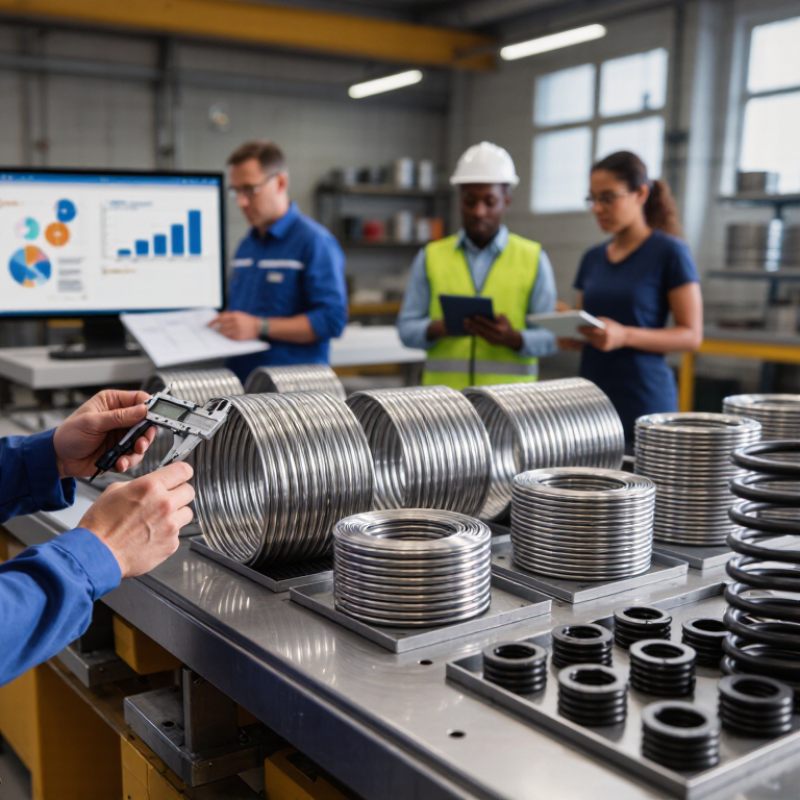
Testing must reflect real service conditions. A capable maker measures load, free length, spring rate, fatigue life, and surface defects. For compression springs, force testing at defined working heights is essential. For wire springs, ASTM A228/A228M provides a useful reference for material requirements. Digital inspection systems can reduce measurement variation, but human review still matters. Machines miss context.

Traceability separates reliable suppliers from convenient ones. Each batch should link to material certificates, furnace records, tooling settings, and final inspection data. The 2024 Manufacturing Quality Benchmark report from the International Quality Federation indicates that poor-quality costs commonly include rework, scrap, delays, and warranty exposure. Exact figures vary by sector, which is easy to overlook. A strong maker therefore reports uncertainty, not just successful results. Ask for capability data, fatigue evidence, and sample retention policies. Also ask what happened during the last failed test. The answer may reveal more than a polished brochure.

How Spring Makers Are Classified by Product and Manufacturing Expertise

Spring makers are best compared by what they build and how they control production. Product focus may include compression springs, extension springs, torsion springs, or precision wire forms. Each type faces different demands. A compression spring needs predictable load and travel. A torsion spring must deliver repeatable rotation without taking a permanent set. Small differences matter.

Manufacturing expertise is another useful measure. Look for capabilities such as wire forming, heat treatment, surface finishing, and inspection. Ask how dimensions are checked and whether samples are tested under working conditions. A maker with suitable equipment should explain material choices, tolerances, and likely failure points in plain language. Clear records help, too. Not just a polished brochure.

Classification is not a ranking. A specialist in small, intricate springs may be a poor fit for large-volume production, while a high-capacity factory may not welcome frequent design changes. That distinction is easy to miss. Share a drawing, expected quantities, operating environment, and target service life before comparing suppliers. Then review sample parts and test results, not promises alone. Even this process has limits: a sample cannot reveal every issue that appears after months of cycling.

Which Companies Lead the Spring Manufacturing Industry in 2026?

In 2026, leading spring manufacturers are distinguished less by size alone than by how reliably they turn design requirements into repeatable parts. Strong suppliers combine experienced engineers, controlled heat treatment, and in-process inspection. Ask how they verify wire diameter, load, and fatigue life—not just whether a sample looks right. Small deviations matter. A spring that measures correctly on a bench can still behave differently after thousands of cycles.

The best manufacturing partners also make their process visible. They can explain material choices, tooling limits, and how production changes are documented. Look for clear test records, traceable batches, and realistic delivery estimates. These details help buyers compare companies on evidence rather than polished claims. Still, no supplier is ideal for every application. A high-volume facility may be efficient but less flexible with unusual geometries; a specialist may offer closer engineering support at a higher cost. I would also question any ranking that names a single “best” maker without explaining its criteria. The right choice depends on the spring’s operating environment, required tolerances, order size, and the quality of communication during development.

What Are the Best Spring Makers in 2026?

Which Companies Lead the Spring Manufacturing Industry in 2026?

In 2026, leading spring manufacturers are generally evaluated by their ability to work with high-performance materials, maintain consistent elastic properties, and meet demanding fatigue and temperature requirements. This chart compares representative room-temperature Young’s modulus values for widely used spring materials. Higher modulus indicates greater stiffness, but it is only one part of overall spring-manufacturing capability.

Values are representative nominal material properties in gigapascals (GPa); actual values vary by grade, heat treatment, wire size, and applicable material standard.

How the Best Spring Makers Compare on Quality, Cost, and Customization

Choosing the best spring maker in 2026 means comparing measurable quality, not polished catalog language. ISO 9001 certification helps, but it does not guarantee consistent spring force. The ISO Survey 2023 recorded more than 1.26 million ISO 9001 certificates worldwide, showing wide adoption but limited differentiation. Strong suppliers also publish load testing, fatigue results, material certificates, and dimensional tolerances. Ask for sample data.

Cost depends on more than the unit price. A lower quote may exclude tooling, inspection, packaging, or corrosion protection. Industry purchasing reports commonly identify raw material prices, energy, and labor as major manufacturing cost pressures. For a fair comparison, request a landed-cost breakdown and a production sample. The cheapest spring can become expensive after early fatigue or uneven coil spacing. That happens.

Customization separates capable makers from simple catalog sellers. Evaluate wire diameter, active coils, spring rate, working travel, surface treatment, and minimum order quantity. ASTM spring-testing standards provide useful methods for checking force and fatigue performance, while ISO 9001 supports process control. However, standards alone cannot replace physical validation. A 2024 NIST manufacturing study also emphasizes measurement traceability and process data for repeatable production.

In practical trials, I would compare three samples under identical loads, temperatures, and cycle counts. Record permanent set, force loss, and visible surface damage. A supplier that explains failures honestly may deserve more trust than one promising zero defects. Custom engineering costs more initially, but it can reduce assembly problems and field replacements. The comparison is imperfect, because every application changes the result.

How to Choose the Right Spring Maker for a Specific Application

Choosing the right spring maker in 2026 starts with the application, not the lowest quotation. A compression spring inside a medical instrument needs different controls from one used in outdoor machinery. Define the load, travel, cycle rate, temperature, space, and corrosion exposure. Small details matter. A one-millimeter error can change performance.

Ask each spring maker for material certificates, dimensional inspection records, and fatigue-test data relevant to your design. Experienced manufacturers should explain wire selection, coil geometry, heat treatment, and surface finishing in practical language. They should also show how they control batch variation. Traceability is essential when springs enter safety-critical assemblies. Independent testing adds confidence, but it should match the actual working conditions.

Review production capability, not only sample quality. Can the maker hold tolerances during larger runs? Can they adjust tooling without delaying your schedule? Clear communication is a technical advantage. I have seen attractive prototypes fail because the supplier ignored assembly friction or expected relaxation. That mistake is easy to repeat. Ask for pilot samples and test them in the complete assembly. Include real vibration, temperature, and repeated movement where possible.

The best spring maker may not be the largest one. Look for documented processes, honest limitations, responsive engineering support, and a willingness to challenge your specifications. A supplier that promises everything deserves careful questioning. Your design may also need revision. That is not failure; it is useful evidence.