Who Are the Best Spring Makers in China? The answer depends on more than factory size, low pricing, or a polished website. Reliable Spring Makers combine material control, accurate forming, consistent heat treatment, and documented testing. Their real strength appears in small details, such as clean coil geometry, stable spring rates, and traceable steel certificates.
W. Edwards Deming, a respected quality-management expert, said, “Quality comes not from inspection, but from the improvement of the production process.” This principle matters deeply in spring manufacturing. A capable Chinese supplier should control wire sourcing, CNC coiling, stress relieving, surface finishing, and final inspection as one connected system. ISO 9001 certification can support confidence, but it cannot replace direct evidence.
Strong manufacturers usually provide sample reports, load testing data, tolerance records, and clear communication during development. They should also understand applications in automotive systems, medical devices, electronics, machinery, and energy equipment. Manufacturing experience matters. So does the ability to adjust tooling without losing repeatability.
Still, choosing the “best” supplier is not completely objective. A maker producing precision miniature springs may not suit heavy suspension components. Cost can also hide risks. Cheap parts may bring unstable performance, delayed delivery, or difficult quality claims.
That sounds simple. It is not.
Buyers should compare factory capability, engineering support, inspection methods, production capacity, and long-term reliability. The strongest Spring Makers do not merely sell springs. They help customers prevent failure before it reaches the assembly line. Even this guide has limits, because supplier performance can change over time. Direct audits, samples, and technical conversations remain essential.
Who Are the Best Spring Makers in China?
A leading spring maker in China is defined by more than production capacity or a low quotation. Strong suppliers control material quality, forming accuracy, heat treatment, and surface protection. They should provide traceable steel certificates and clear inspection records. Their engineers also understand fatigue, load requirements, working temperature, and installation space.
A reliable factory tests springs under realistic conditions. For example, compression springs may undergo repeated cycling while technicians record force loss and permanent deformation. Dimensional checks should cover wire diameter, free length, coil diameter, and end shape. Communication matters too. Good engineers ask for drawings, application details, and failure history before suggesting changes. Still, no supplier is perfect. A polished sample can hide weak process control, so one successful batch proves very little.
Tips: Request a pilot run before placing a large order. Ask how rejected parts are separated and documented. Review inspection reports, calibration dates, and material records. Visit the workshop when possible. Look for organized tooling, clean testing areas, and operators who can explain their work. Price deserves attention, but unclear tolerances deserve more. The best spring maker is usually the one that admits limitations, explains risks, and improves after testing.

China’s spring manufacturing industry is organized around regional clusters, specialized workshops, and integrated production plants. Many factories focus on compression, extension, torsion, or precision springs. Others combine several processes under one roof. This structure lets buyers match production capacity with technical requirements.
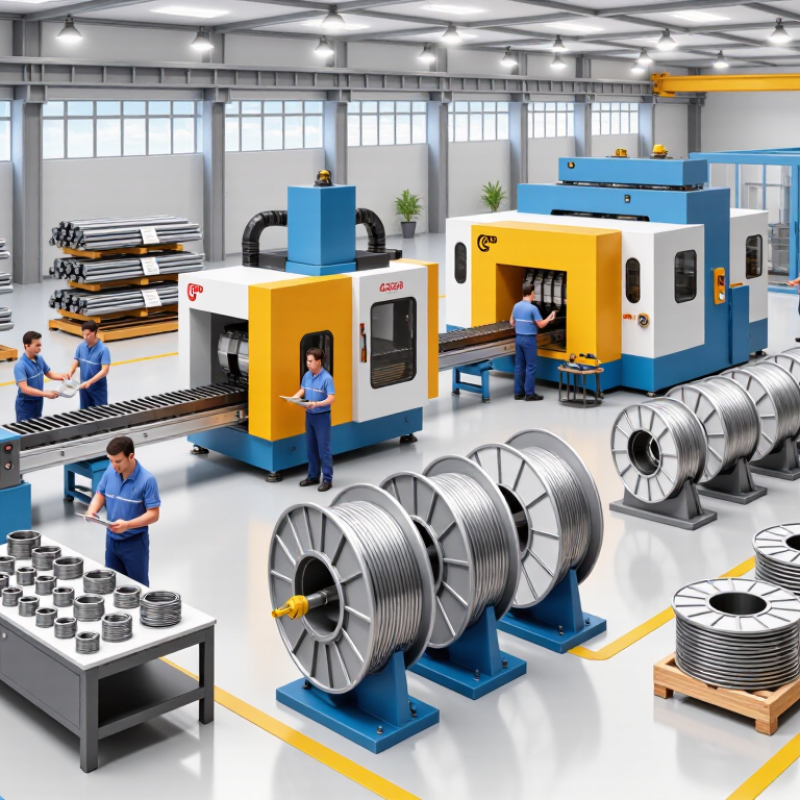
The supply chain usually begins with steel wire distributors and material processors. Spring makers then handle coiling, forming, heat treatment, grinding, and surface treatment. Larger plants may operate automated coiling lines and laboratory equipment. Smaller workshops often provide flexible tooling and fast samples. In practice, the boundary is not always clear. Some small suppliers deliver excellent prototypes, yet struggle with stable mass production.
Experienced buyers examine more than equipment lists. They review material certificates, process records, sample measurements, and inspection methods. Useful checks include load testing, fatigue testing, dimensional control, and surface inspection. A reliable factory should explain how it manages wire diameter, coil pitch, free length, and production changes. Traceability matters when a batch contains thousands of parts.
China’s industry also includes trading companies and engineering intermediaries. They can coordinate suppliers, but their technical understanding varies. Direct factory communication is safer for complex designs. Drawings should specify tolerances, operating temperature, corrosion conditions, and expected cycles. Small details matter. A spring that looks correct may lose force after repeated movement. Factory audits remain valuable, although one visit cannot reveal every weakness. Quality depends on daily discipline, not only impressive machinery.
| Industry Dimension | Main Categories | Verified Industry Characteristics | What Buyers Should Evaluate |
|---|---|---|---|
| Product Structure | Compression, tension, torsion, flat, disc, wave and wire forms | Helical compression springs are widely used in machinery, vehicles, appliances and general hardware. Torsion and tension springs are commonly produced for mechanisms, hinges, latches and actuators. | Confirm the spring type, load requirement, working stroke, free length, coil diameter, end configuration and allowable dimensional tolerances. |
| Material System | Carbon spring steel, alloy spring steel, stainless steel and copper-based alloys | Material selection depends on fatigue life, corrosion exposure, operating temperature, conductivity and required strength. Carbon and alloy spring steels are widely used for mechanical applications, while stainless steel is selected for corrosion resistance. | Request the material grade, mill certificate, chemical composition, hardness or tensile-strength results, surface condition and traceability information. |
| Manufacturing Routes | Cold coiling, hot forming, stamping, CNC wire forming and heat treatment | Small and medium wire diameters are commonly formed by cold coiling or CNC wire forming. Larger sections and high-load products may require hot forming, stress relieving, quenching, tempering or shot peening. | Check whether the producer controls forming, heat treatment, end grinding, setting, shot peening and final inspection in-house or through qualified subcontractors. |
| Regional Organization | Yangtze River Delta, Pearl River Delta and other industrial manufacturing areas | Spring suppliers are concentrated near China’s automotive, electronics, appliance, machinery, hardware and export-manufacturing supply chains. Regional specialization often reflects the dominant industries in each manufacturing area. | Evaluate logistics access, local material availability, engineering support, subcontractor control and the supplier’s experience with the target application. |
| Customer Segments | Automotive, industrial equipment, electronics, appliances, furniture, tools and consumer products | Automotive and industrial customers usually require stronger process control and documentation. General hardware and consumer-product programs often place greater emphasis on cost, speed, appearance and flexible batch sizes. | Match the supplier’s quality system, testing capability, production scale and compliance documentation to the risk level of the end use. |
| Quality Standards | National standards, customer drawings and international quality systems | Chinese spring production may reference standards such as GB/T 1239.2 for cold-coiled helical spring requirements and GB/T 4357 for carbon spring steel wire. Automotive programs commonly add customer-specific validation requirements. | Use a controlled drawing and technical specification covering dimensions, force or torque, fatigue testing, surface defects, sampling plans and inspection records. |
| Testing Capability | Dimensional inspection, load testing, torque testing, hardness, metallography and fatigue testing | Spring performance is determined by both geometry and material condition. Load or torque testing verifies functional behavior, while fatigue testing is important for cyclic applications such as vehicles, valves and industrial mechanisms. | Review equipment calibration, test fixtures, sampling frequency, test temperature, acceptance criteria and the supplier’s ability to provide repeatable inspection data. |
| Surface Protection | Oil coating, phosphate treatment, electroplating, passivation, painting and shot peening | Surface treatment is selected according to corrosion risk, appearance requirements, friction conditions and fatigue performance. Shot peening can improve fatigue resistance when correctly controlled. | Specify coating thickness, salt-spray or corrosion requirements, hydrogen-embrittlement controls where applicable, masking areas and post-treatment dimensional limits. |
| Supplier Tiers | Commodity producers, custom manufacturers and high-specification suppliers | Commodity producers focus on standard parts and competitive volume pricing. Custom manufacturers support drawing-based products, while high-specification suppliers typically provide stronger validation, traceability and process documentation. | Select the supplier tier according to product criticality, annual volume, tolerance requirements, qualification workload and expected product life. |
| Cost Drivers | Raw material, wire diameter, geometry, tooling, heat treatment, finishing and inspection | Material consumption and forming complexity are major cost factors. Small batches may carry higher tooling and setup costs, while tight tolerances, special alloys, fatigue testing and surface treatments increase total unit cost. | Compare quotations using the same material grade, annual volume, tooling ownership, packaging method, inspection scope, delivery terms and revision-control requirements. |
| Export Readiness | Documentation, packaging, traceability, customs support and international communication | Export-oriented spring manufacturers generally need to manage technical drawings, inspection reports, packing lists, commercial documentation and shipment protection for moisture-sensitive steel products. | Confirm drawing-language capability, response time, export experience, packaging validation, lot traceability, corrective-action procedures and continuity planning. |
Note: The most suitable spring manufacturer is determined by application risk, material requirements, dimensional tolerance, testing needs, production volume and quality-documentation capability—not by price alone.
China’s spring makers produce far more than standard compression coils. Their ranges commonly include extension springs, torsion springs, wire forms, disc springs, wave springs, and precision stamping parts. Compression springs support valves, seats, battery contacts, and industrial equipment. Extension springs use hooks to create pulling force. Torsion springs work around hinges, clamps, and latches. Wire forms can be bent into clips, retainers, or custom frames.
Market data shows why this variety matters. Grand View Research estimated the global industrial springs market at approximately US$18 billion in 2023, with steady growth expected through 2030. Reports differ slightly because some include automotive components while others exclude them. That difference deserves attention. Chinese manufacturers often serve automotive, electronics, medical equipment, construction, and automation industries. In factory visits, practical details matter: wire diameter, coil spacing, surface finish, fatigue life, and load testing. A spring may look correct but fail after repeated cycling.
Tips: Ask for material certificates, load-deflection curves, salt-spray results, and fatigue-test records. Confirm whether measurements follow ISO or ASTM methods. For stainless steel parts, check the actual grade, not only the supplier’s description. Packaging also matters; poorly protected coils can arrive with scratches or distorted hooks. A reliable maker should explain tolerances clearly and provide samples before mass production. My own caution is simple: low price can hide inconsistent heat treatment, and visual inspection alone is never enough.
Finding the best spring maker in China starts with evidence, not a polished catalog. Quality should be measurable at the wire, coil, and finished-part stages. Ask for material certificates, tensile results, hardness readings, and batch traceability. Check whether inspection uses calibrated gauges and documented sampling plans. ISO 9001 certification helps, but it does not guarantee spring performance. The ISO Survey 2022 recorded more than 1.2 million ISO 9001 certificates worldwide. That number shows the system’s reach, not each factory’s discipline. Request recent corrective-action records. A certificate can age faster than a process.
Technology appears in repeatability. Review CNC coiling, heat treatment, shot peening, and automated optical inspection. Ask for tolerance capability studies, not only machine lists. Process capability indices, such as Cpk, should be tied to drawing tolerances. For fatigue-sensitive parts, request test data covering cycle life and load retention. UNIDO’s 2024 International Yearbook reports that China accounted for about 31% of global manufacturing value added in 2023. Large capacity is plausible, yet capacity claims need proof. Compare monthly output, shift patterns, equipment counts, and peak-load plans. Run a pilot order and inspect spring rate, free length, surface finish, and packaging. Small samples can hide variation. Any evaluation can be imperfect when production changes between batches. Supplier selection should leave room for retesting.
China’s spring manufacturing strength is concentrated in several industrial regions. Zhejiang is a major center, especially around Ningbo, Yuyao, and Taizhou. These areas support compression, extension, torsion, and wire-form spring production. Many factories serve automotive, electronics, hardware, and appliance sectors. Their advantages include experienced technicians, dense supply chains, and flexible tooling services.
Jiangsu is another important region. Nantong, Suzhou, and Kunshan offer strong capabilities in precision forming and automated production. Suppliers there often work with stainless steel, carbon steel, and specialty alloys. Guangdong, including Dongguan, Foshan, and Shenzhen, is known for fast prototyping and close integration with electronics manufacturing. Small springs, battery contacts, and precision stamped parts are common products in this region. Fast response matters.
Shandong and Hebei also deserve attention for industrial springs and heavier wire products. Their factories may provide larger diameters, stronger load capacity, and more practical pricing. However, regional reputation alone is not enough. Buyers should inspect material certificates, heat-treatment records, dimensional reports, and fatigue-test data. A factory can look impressive yet lack stable process control. That happens.
During supplier evaluation, check coil consistency under magnification and measure samples from different production batches. Ask how they control burrs, surface rust, and stress relaxation. Local access to wire mills and plating facilities can reduce lead times, but quality still depends on management. The “best” maker is usually the one that documents limitations honestly and improves after testing. That detail is easy to overlook.