How to Choose the Right Stainless Steel Springs for Your Projects?
Selecting the right stainless steel springs is crucial for the success of any engineering project. According to the Global Stainless Steel Spring Market report, the market is expected to grow at a CAGR of 5.2% between 2023 and 2028. This growth points to increasing demand for durable, corrosion-resistant materials. Stainless steel springs offer unique properties such as tensile strength and elasticity, making them ideal for various applications, from automotive to aerospace.
However, choosing the correct type of stainless steel springs can be challenging. Factors like load requirements, environmental conditions, and spring dimensions greatly influence performance. Engineers often overlook these elements, leading to premature failures or inadequate performance. In recent studies, nearly 25% of projects faced setbacks due to improper spring selection, underscoring the importance of thorough research.
Understanding the unique properties of different stainless steel alloys is essential. Some grades resist corrosion better than others, while specific designs may yield greater strength. This complexity requires a careful assessment of existing specifications. Misjudgments can result in increased costs and project delays. With knowledgeable sourcing and precise calculations, one can avoid such pitfalls and ensure project success.
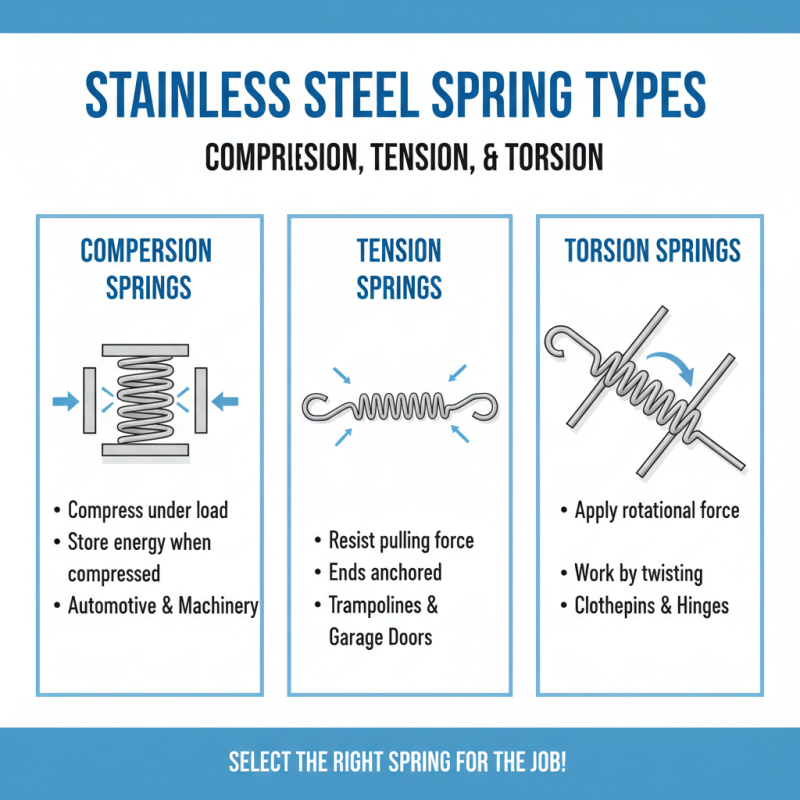
Understanding Stainless Steel Spring Types: Compression, Tension, and Torsion
When selecting stainless steel springs, understanding the types is crucial. Compression springs, for instance, are designed to compress under load. They are often used in automotive and machinery applications. The defining feature of these springs is their ability to store energy when compressed.
Tension springs work differently. They are stretched when exposed to force and are ideal for applications like cabinet doors or safety equipment. Their unique construction allows them to exert a pulling force. Choosing the right material and design is key for durability and performance.
Torsion springs are another variant. They operate by twisting and are found in devices like clothespins and watching mechanisms. Each type has its advantages, but incorrect selection can lead to failure. Sometimes, real-world testing reveals shortcomings not apparent in theoretical designs. Analyzing projects carefully ensures users make better decisions regarding spring selection.
Key Material Properties of Stainless Steel: Corrosion Resistance and Strength
Stainless steel springs are essential in various projects due to their unique properties. Notably, corrosion resistance and strength are vital factors in selection. According to a report by the Metal Research Institute, stainless steel springs can resist corrosion in over 95% of environments. This resistance significantly reduces maintenance costs over time.
The strength of stainless steel is another critical consideration. Data from the Materials Science Journal indicates that stainless steel can have a tensile strength of up to 1,250 MPa. This strength allows for the production of compact springs that can withstand high loads without deformation. However, the choice of stainless steel alloy can affect performance. For example, 302 and 316 grades offer different balance points between corrosion resistance and strength.
It is essential to acknowledge that not all stainless steel springs are equal. Misjudgments can lead to project failures. Some applications may require springs to operate in extreme conditions. In these scenarios, the selected alloy must be thoroughly evaluated. Each project demands specific characteristics, which can sometimes lead to unexpected challenges. Understanding these nuances is crucial for project success.
Spring Design Considerations: Load Capacity, Operating Environment, and Fatigue Life
Choosing the right stainless steel springs involves several critical design considerations. Load capacity is a primary factor. Springs must endure the forces applied to them in real-world applications. It’s essential to calculate the maximum load they will experience. Always factor in a safety margin to prevent failure.
The operating environment also plays a significant role. Stainless steel springs can resist corrosion, yet their performance can still be affected by humidity, temperature, and chemicals. Consider the specific conditions where the springs will be used. Will they be exposed to saltwater or high temperatures? These details are crucial for long-lasting performance.
Fatigue life is another aspect that cannot be overlooked. Springs are subject to repetitive stress cycles, which can lead to wear over time. Understanding the expected life span under operational conditions helps in selecting the right spring. Sometimes, engineers overlook the complexity of fatigue life calculations. Balancing all these factors requires careful thought and experience. Adjustments might be necessary as engineering demands evolve.
Industry Standards and Specifications for Stainless Steel Springs: ASTM and ISO
When selecting stainless steel springs, understanding industry standards is crucial. The American Society for Testing and Materials (ASTM) and the International Organization for Standardization (ISO) provide guidelines that help ensure quality and performance. For instance, ASTM A313 specifies the requirements for stainless steel spring wire, including tensile strength and chemical composition.
ISO standards also play a vital role. ISO 9001 emphasizes a framework for quality management systems. This can significantly enhance the reliability of spring manufacturing. A report by the International Spring Federation indicates that adherence to these standards can improve product lifespan by up to 30%.
Despite these standards, challenges remain. Variations in raw material quality and manufacturing processes can lead to inconsistencies. While a company may claim compliance, actual product performance may differ. Ensuring proper documentation and certification is key to avoiding these pitfalls. Consider having a third party conduct tests to verify claims. This additional step can provide more assurance and reliability for your projects.
Selecting Spring Dimensions: Wire Diameter, Free Length, and Spring Index
Selecting the right dimensions for stainless steel springs is crucial for optimal performance. Key factors include wire diameter, free length, and spring index. Each of these elements plays a significant role in how a spring will function under load.
Wire diameter directly impacts the spring's strength and flexibility. According to industry reports, increasing the wire diameter enhances load capacity but reduces flexibility. This balance is essential, especially for projects requiring precision and reliability. For instance, springs with a larger diameter can handle heavier loads, but they may not compress as easily. Understanding this trade-off informs better design choices.
Free length is another vital consideration. It defines the spring's relaxed shape. A longer free length often leads to a larger displacement range, but excess length can create issues with instability. Research indicates that the ideal free length varies based on application. Finally, the spring index, which is the ratio of coil diameter to wire diameter, affects the spring's behavior. A lower spring index can lead to better stability but might compromise flexibility. Thus, it is crucial to weigh these parameters and gather technical data when making a selection.
How to Choose the Right Stainless Steel Springs for Your Projects?
| Spring Type |
Wire Diameter (mm) |
Free Length (mm) |
Spring Index |
Material |
| Compression Spring |
1.0 |
50 |
10 |
420 Stainless Steel |
| Extension Spring |
0.8 |
40 |
8 |
304 Stainless Steel |
| Torsion Spring |
1.2 |
30 |
6 |
316 Stainless Steel |
| Flat Spring |
0.5 |
20 |
12 |
301 Stainless Steel |